Akhanda 2: Tandavam Review – Mass Overdose Fails to Impress
Movie Review: ‘Akhanda 2: Tandavam’
Cast: Nandamuri Balakrishna, Samyukta, Aadi Pinisetty, Harshali Malhotra, Shashwata Chatterjee, Kabir Singh Dulhan, Sharath Lohitasva, Poorna and others
Music: Thaman
Cinematography: Ram Prasad- Santosh Detake
Producers: Ram Achanta- Gopinath Achanta
Written-Directed by: Boyapati Srinu
Nandamuri Balakrishna and Boyapati Srinu are known for their successful mass-oriented films. Their previous collaborations, such as Simha, Legend, and Akhanda, were all major hits. Now, they return with the sequel, ‘Akhanda 2: Tandavam’. The film faced some release delays, moving from its original December 5th date. Despite the postponement, anticipation remained high. We will see if the movie delivers on those expectations on screen.
Story:
Muralikrishna (Balakrishna) serves as an MLA in the Rayalaseema region. His daughter, Janani (Harshali Malhotra), works as a scientist at DRDO, where she develops a specialized bio-suit designed to help soldiers survive in extreme environments. During the suit’s testing phase, a Chinese Army General conspires with an Indian politician to destabilize the country. They plan a dangerous attack by releasing a virus into the Ganga River, aiming to affect millions attending the Kumbh Mela and cause widespread panic. Janani then takes on the challenge of creating a vaccine for this virus, but some individuals attempt to sabotage her efforts. At this critical juncture, Muralikrishna’s brother, Akhanda (Balakrishna), an Aghori, intervenes. The rest of the story follows his efforts to protect the nation from these adversaries and the lengths he goes to.
Analysis:
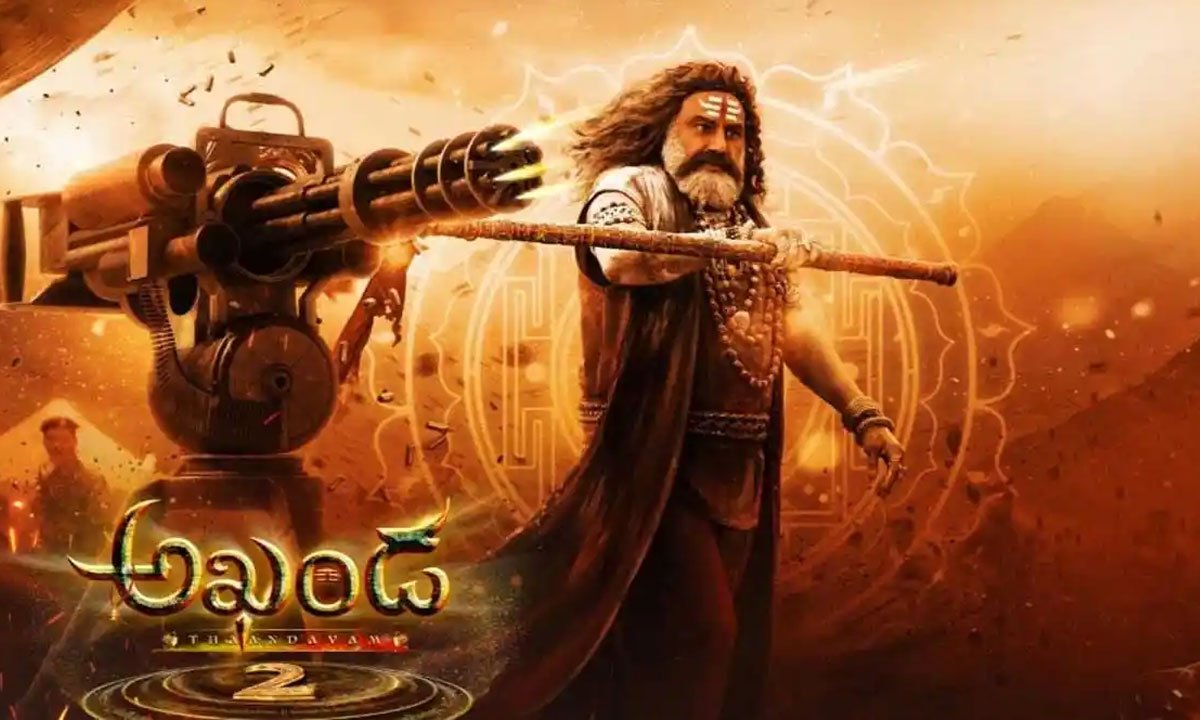
The impact of a ‘mass’ scene often depends on the hero’s persona. While some actors might make such scenes appear exaggerated, Balakrishna is an actor who can push the boundaries of mass elements. This extreme approach has worked for him at times. Director Boyapati is also recognized for his over-the-top action sequences. With high expectations for this popular mass combination, many anticipated an unparalleled display of action. However, after three consecutive blockbusters, it seems they approached Akhanda 2 with the belief that anything they did would be well-received. The film pushes beyond loud and extreme, ultimately coming across as mediocre. Examples include turning a man around for aarti, using a Trishul to spin a helicopter’s blades, firing a machine gun with the same Trishul, reaching areas inaccessible to the Indian army, and single-handedly fighting China to kill their Army General. These unusual stunts, presented as mass cinema, fill the movie and, from another perspective, resemble material for online trolling.
After directing two conventional mass films with Balayya, Boyapati introduced a divine element into their third collaboration, Akhanda, giving the hero a second role as a devout Lord Siva follower. That film arrived when mythological and divine themes were popular, contributing to Akhanda’s massive success. However, in crafting the sequel, Akhanda 2, Boyapati amplified everything: more mass, more elevation, and a stronger divine touch. This became excessive at a certain point. Not only did the mass scenes exceed all limits, but the divine elements also went overboard. As a result, the film lacked the natural and powerful feeling that Akhanda 1 possessed.
Despite all the exaggeration, the film still offers moments that will appeal to the masses. The interval sequence, showing the Aghora’s return, is particularly exciting. The scene where Balayya experiences the ‘Poonakam’ of Lord Hanuman is also impactful. Many action sequences are designed purely for spectacle, but they lack an emotional core. The villains appear too weak, making the entire setup feel unrealistic. The supposedly powerful tantric villain looks menacing but cannot stand against Akhanda in their two encounters. Similarly, the Chinese army chief and his soldiers seem like mere puppets before Akhanda. Much like a video game where a central character with a spear defeats everyone, Akhanda here eliminates all adversaries, including armed goons, a powerful tantric, and an army chief. The movie’s thrilling aspect diminishes because the hero is consistently portrayed at his absolute peak.
Nobody expects strict logic in Boyapati’s films, as his narratives typically weave between heroism and action sequences. This time, in an attempt to position Akhanda 2 as a pan-India film, he incorporated elements like the Kumbh Mela and a virus plot. However, these additions simply failed to connect and resulted in a misfire. Dialogues about Sanatana Dharma are catchy at times, but the surrounding scenes feel quite exaggerated. The Shiva element does not evoke the same genuine emotion it did in the first Akhanda. The emotional bond audiences felt with the original is absent here, largely because the action elements were pushed to such extremes that the character’s essence was lost. Overall, Akhanda 2 struggles to capture the spirit of its predecessor, and the excessive mass elements make it difficult to satisfy viewers.
Actors:
Nandamuri Balakrishna once again portrayed Akhanda with ease, delivering a strong performance as expected. His dialogue delivery is forceful and impactful. However, his appearance as the older Akhanda did not quite work, with the makeup looking somewhat unnatural. A different approach might have been better; he looks best in scenes where he uses the same getup from the previous film. As Muralikrishna, he fits the role well.
Samyukta, playing the heroine, appears very glamorous in the Jajikaya song, drawing some attention. Harshaali Malhotra (known from Bajrangi Bhaijaan), who plays his daughter, is merely adequate in her role. None of the villains made a lasting impression, including Aadi Pinisetty, who put considerable effort into his makeup for the tantric character. His role never truly connects with the audience. Shashwatha Chatterjee, as the Chinese Army Chief, is quite average, while Kabir Singh Dulhan performs well as Thakur. Sarvadhaman Banerjee, playing the Prime Minister, does not stand out significantly, and other cast members like Sarath Lohitaswa and Poorna are just acceptable.
Technician:
SS Thaman, true to form, delivers loud music that certainly gets attention, but his songs were often overshadowed by the background score, making it hard to assess them individually. The Sanskrit chants in the background score for the hero’s entry scenes are effective, yet the overall score became so loud that it was difficult to discern specific sounds. Thaman should reconsider the idea that excessive instrumentation and high-decibel scores automatically equate to ‘mass’ music. Cinematography by Ram Prasad and Santosh Datake appears solid, with rich visuals serving as proof. The substantial budget is clearly visible on screen, supported by impressive production design.
Regarding writer-director Boyapati Srinu, Akhanda 2 serves as a reminder that he needs to move beyond his established mass template. The movie offers nothing to commend Boyapati’s storytelling or screenplay abilities. While Boyapati’s signature formulas previously worked for Balakrishna, this time, the excessive mass elements rendered them ineffective. Even with Balayya, the mass sequences went too far, crossing acceptable boundaries.
Finally: Akhanda 2… Mass Overdose
Rating – 2.25/5
Tags: akhanda2, thaandavam, balakrishna, nandamuribalakrishna, akhanda2movie, akhanda2review, moviereview